
Best All-in-One Marketing Platforms for Small Business (2026)
Too many tools, rising costs, and broken workflows? Learn how all-in-one marketing platforms can simplify your stack and help you scale with clarity.

If your marketing stack feels harder to manage than your actual marketing, you are not alone.
The more tools you add, the harder your system becomes to manage. And most businesses reach that point faster than they expect.
Most small businesses start simple. One email platform. A landing page builder. Maybe a CRM. Then over time, more tools get added to solve new problems. Automation tools. Analytics platforms. Scheduling tools. Funnel builders.
What starts as a solution slowly turns into a system that is expensive, disconnected, and difficult to manage.
Campaigns take longer to launch. Data lives in multiple places. Automations break. And instead of helping your business grow, your tools begin to slow you down.
This is not a performance problem. It is a systems problem.
All-in-one marketing platforms promise a different approach. Instead of stitching together multiple tools, they bring your core marketing functions into one place.
The question is not whether you need better tools. It is whether you need fewer tools that actually work together.
If you need a clearer framework for how your marketing systems should be structured, start with our guide to building a simple MarTech stack.
The reality is that most small businesses are not under-tooled. They are over-tooled and under-structured.
What Is an All-in-One Marketing Platform?
An all-in-one marketing platform combines multiple core marketing functions into a single system.
Most platforms include:
- Email marketing
- Automation workflows
- Landing pages or funnels
- Contact management or CRM
- Basic analytics and reporting
Instead of managing five or more tools, you operate within one system that is designed to work together.
This reduces friction, simplifies workflows, and makes your marketing easier to manage as you grow.
Why Most Businesses End Up Over-Tooled
Most marketing stacks do not become complex overnight. They grow slowly through small decisions.
- A new tool to fix a gap
- Another platform for automation
- A separate system for reporting
Each decision makes sense in the moment. But over time, those tools stop working as a system.
Instead, they compete.
You end up with overlapping functionality, disconnected data, and workflows that rely on manual fixes just to function.
At some point, more tools stop helping and start getting in the way.
Signs You Need an All-in-One Platform
Not every business needs to consolidate tools. But if your system is starting to feel harder to manage than it should be, that is a signal.
Common signs include:
- Multiple tools performing the same function
- Manual work required to connect systems
- Inconsistent or unreliable data
- Increasing monthly software costs
- Avoiding your own tools because they feel overwhelming
When your tools become something you avoid instead of rely on, your system is working against you.
When an All-in-One Platform Makes Sense
All-in-one platforms are not for everyone, but they are a strong fit for:
- Solopreneurs managing everything themselves
- Small teams with limited resources
- Businesses looking to simplify operations
- Companies prioritizing efficiency over complexity
If your goal is to reduce friction and operate with clarity, consolidation is often the right move.
If you’re just getting started, our breakdown of the best marketing tools for small business can help you explore your options before consolidating.
When It Does Not Make Sense
There are cases where an all-in-one platform is not the right solution.
These include:
- Enterprise organizations with complex infrastructure
- Businesses requiring highly specialized tools
- Advanced data environments with custom integrations
The goal is not fewer tools at any cost. It is the right level of complexity for your business.
What a Well-Structured Marketing System Actually Looks Like
A simplified marketing stack is not just about reducing the number of tools. It is about creating a system where each part has a clear role.
In a well-structured system:
- Data flows cleanly between tools
- Automation supports your workflows instead of complicating them
- Reporting reflects what is actually happening in your business
- Each platform serves a specific purpose
There is no duplication. No confusion. No unnecessary complexity.
This is what allows small teams to operate like larger organizations without needing additional resources.
If you want a deeper look at how to structure your stack at a system level, revisit our guide to building a simple MarTech stack.
Best All-in-One Marketing Platforms for Small Business
There is no single platform that works for everyone. The best choice depends on how your business operates and what level of complexity you actually need.
Below are a few strong options to consider.
systeme.io
Best for: Simplifying your marketing stack
Key strength: All-in-one system with fewer tools and less complexity
ConvertKit
Best for: Creators and content-driven businesses
Key strength: Email-first approach with strong audience management
MailerLite
Best for: Small teams and beginners
Key strength: Simple automation with a low learning curve
systeme.io
For many small businesses, the biggest advantage is not more features. It is having fewer moving parts. When your email, automation, and funnels live in one system, your marketing becomes easier to manage and significantly faster to execute.
systeme.io is designed for businesses that want to simplify their marketing systems without sacrificing essential functionality.
It combines email marketing, automation, landing pages, funnels, and basic CRM functionality into a single platform.
Instead of managing multiple tools, you can run your core marketing activities in one place.
Why it works:
- Reduces tool switching
- Simplifies workflows
- Lower cost compared to multiple subscriptions
- Designed for ease of use
Many businesses do not need more advanced features. They need fewer moving parts and a system that is easy to maintain. This is where simpler platforms often outperform more complex stacks.
Best for:
- Solopreneurs
- Lean teams
- Digital product businesses
- Anyone looking to reduce tool overload
Limitations:
- Not built for enterprise-level complexity
- Fewer advanced integrations than larger platforms
If you want a deeper comparison of how this platform stacks up against other tools, see our full breakdown here.
Kit (ConvertKit)
Kit is a creator-focused platform designed primarily for email marketing and audience growth.
It offers a simpler approach compared to larger systems and is well-suited for businesses that rely heavily on content and email-driven strategies.
Best for:
- Creators
- Bloggers
- Audience-first businesses
MailerLite
MailerLite is a lightweight platform that combines email marketing, automation, and landing pages at a lower cost.
It is often used by businesses that want a simple system without a steep learning curve.
Best for:
- Small businesses
- Budget-conscious teams
- Simpler marketing needs
How to Choose the Right Platform
Choosing the right platform is less about features and more about how your system works.
Before making a decision, ask:
- What workflows are essential to your business?
- Which tools are overlapping?
- Where are you losing time or clarity?
The best platform is not the one with the most features. It is the one that reduces friction in your system.
If your current setup already feels complex, start by learning how to simplify your MarTech stack before making any major changes.
Common Mistakes to Avoid When Choosing an All-in-One Platform
Choosing the wrong platform often creates the same problems you were trying to solve.
One of the most common mistakes is selecting a tool based on features instead of workflows. A platform may offer everything you think you need, but if it does not align with how your business actually operates, it will feel difficult to use.
Another mistake is trying to migrate everything at once. Moving your entire system without testing workflows can lead to broken automations, lost data, and unnecessary frustration.
Cost can also be misleading. Some platforms appear more affordable upfront but require additional tools or upgrades over time, bringing you back to the same level of complexity you were trying to avoid.
Finally, many businesses underestimate the importance of simplicity. A tool that is easier to use consistently will outperform a more powerful system that is rarely used effectively.
The goal is not to find the most advanced platform. It is to find the one you can operate with clarity and consistency.
What Most “All-in-One” Platforms Do Not Tell You
All-in-one platforms are often positioned as the simplest solution. And in many cases, they are.
But there is a nuance that most businesses do not consider before switching.
An all-in-one platform does not automatically fix a broken system.
If your workflows are unclear, your data is disorganized, or your processes are inconsistent, those issues will follow you into any platform you choose.
The tool does not create the system. It supports it.
This is why some businesses switch platforms and still experience the same problems. The issue was never the tool itself. It was the lack of structure behind it.
Before moving to any new platform, it is critical to understand how your marketing actually operates.
- What triggers your campaigns
- How leads move through your system
- Where handoffs happen between tools or steps
Once those are clear, the platform becomes much easier to implement and manage.
Without that clarity, even the best tool will feel difficult.
How to Transition Without Breaking Your System
One of the biggest risks with all-in-one platforms is not the tool itself, but how you transition.
Many businesses try to move everything at once. This often leads to broken workflows and lost data.
A better approach:
- Start with one core function (email or automation)
- Test workflows before fully migrating
- Gradually phase out old tools
- Keep systems stable during transition
Most failures with all-in-one platforms happen during transition, not selection.
Simplifying Your Stack Is Not About Having Fewer Tools
It is about having the right tools working together.
More tools do not create better systems. Better systems create better outcomes.
When your tools are aligned, your marketing becomes easier to manage, faster to execute, and more reliable.
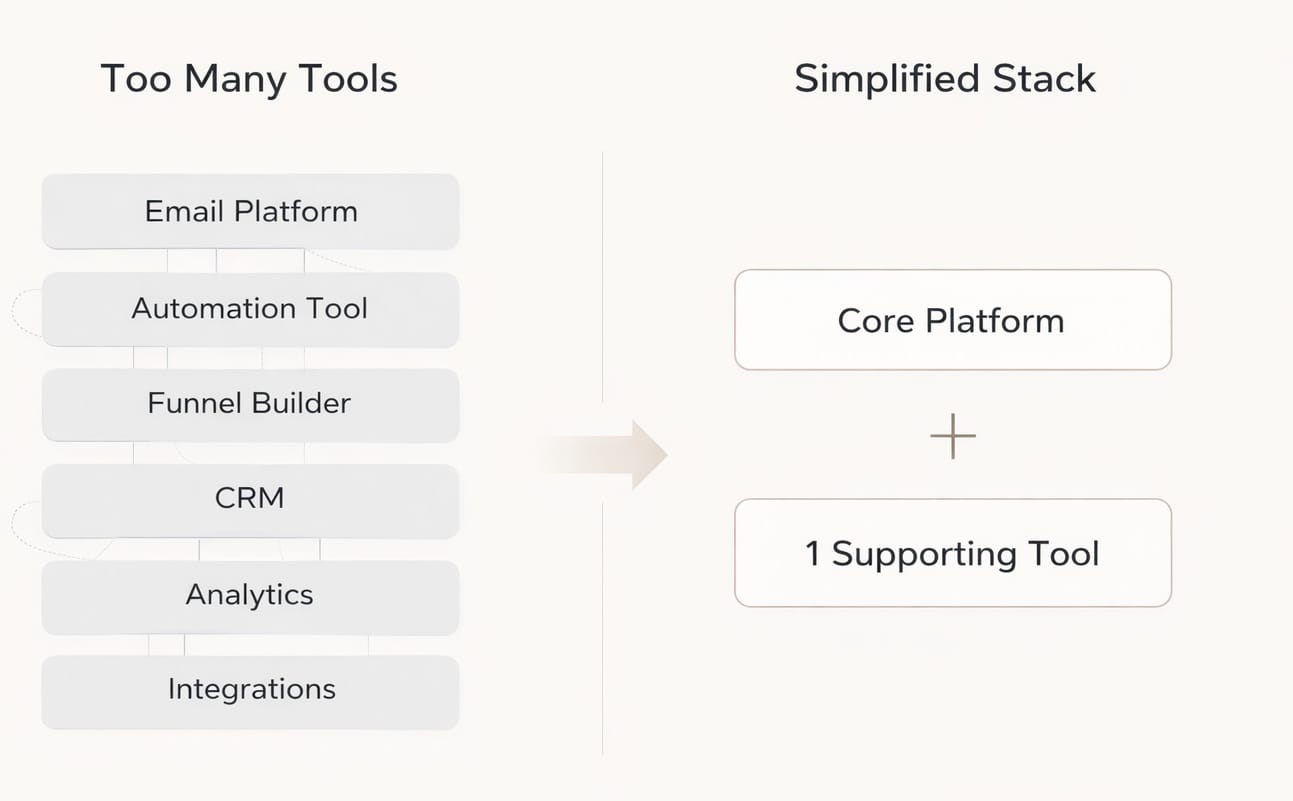
A Simple Example: Before and After Simplifying Your Stack
To understand the impact of simplification, it helps to look at a real-world scenario.
Before:
- Email platform for newsletters
- Separate automation tool
- Landing page builder
- CRM system
- Analytics platform
- Scheduling and integration tools
Each tool serves a purpose, but none of them are fully connected. Data is duplicated. Workflows require manual steps. Reporting is inconsistent.
After:
- One core platform handling email, automation, and pages
- One supporting tool for analytics or specialized needs
Now:
- Data lives in one place
- Workflows are easier to manage
- Campaigns launch faster
- Costs are reduced
The difference is not just fewer tools. It is a system that works together instead of against itself.
Why Most Businesses Still Overcomplicate Their Stack
Even after recognizing the problem, many businesses continue adding tools instead of simplifying.
This happens because new tools feel like progress. They promise better automation, better insights, or faster results.
But without a clear system, each new tool adds another layer of complexity.
The result is not better performance. It is a system that becomes harder to manage over time.
Simplification is not about removing capability. It is about removing friction.
Simplify Your Stack Without Breaking Your System
If your current setup feels harder to manage than it should be, the first step is not adding another tool.
It is understanding what you already have.
Most businesses wait too long to simplify their stack. By the time they act, complexity has already slowed growth.
Download the free 10-Minute SaaS Audit Checklist and map your stack in under an hour.
FAQ
What is the best all-in-one marketing platform for small business?
The best platform depends on your needs, but tools like systeme.io are strong options for simplifying core marketing functions into one system.
Are all-in-one platforms better than using multiple tools?
They can be, especially for smaller teams. All-in-one platforms reduce complexity, improve efficiency, and lower costs when used correctly.
Can I switch to an all-in-one platform without losing performance?
Yes. In many cases, performance improves because systems are more aligned and easier to manage. The key is transitioning carefully.
Do I still need multiple tools?
In some cases, yes. The goal is not eliminating tools entirely, but reducing unnecessary complexity and overlap.
About MarTech Authority
MarTech Authority provides practical, system-focused insights on marketing tools, automation, and infrastructure. Our goal is to help you simplify your stack and build systems that actually drive results, not just activity.
Please note that we only recommend tools and platforms that we believe provide real value. Your results will depend on how you use these tools and your overall strategy.

Comments ()