
Simple MarTech Stack for 2026: A Lean Framework for Growth
Most marketing stacks are built by accident through years of reactive buying. This post outlines the three-layer architectural framework, Intelligence, Engine, and Visibility, required for a lean, scalable marketing system.

The most common question we hear from solopreneurs, consultants, and business leaders is simple:
“What tools should I actually be using?”
In 2026, the answer is not “more.”
The answer is interoperability.
A stack that does not talk to itself is not a stack. It is a collection of expensive silos. And in many cases, those silos are the reason growth feels harder than it should.
After performing an infrastructure audit, we see the same pattern repeatedly. Organizations are over-tooled, under-integrated, and unclear on which platforms actually matter.
This guide breaks down the Director-level MarTech stack into five essential layers. The goal is not to prescribe tools, but to give you a lean framework for evaluating what belongs in your system and what does not.
A simplified view of a lean marketing tech stack:
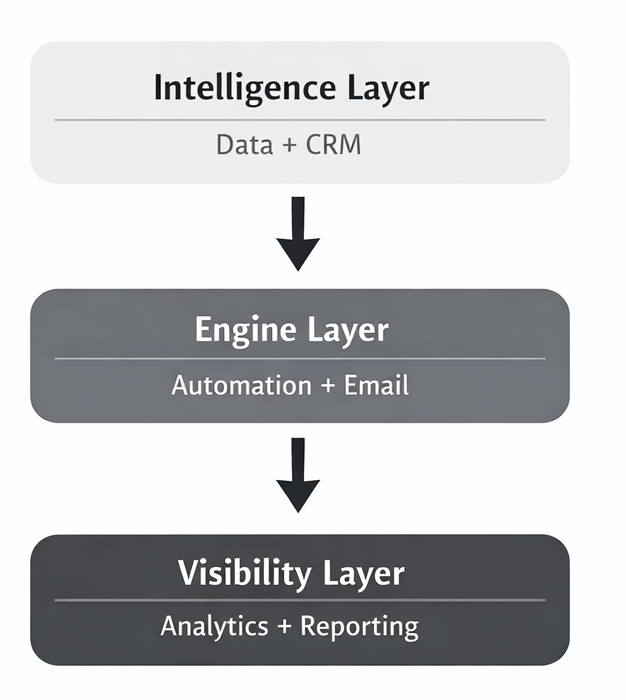
What a Simple MarTech Stack Looks Like in Practice
These examples show what a simple martech stack can look like for different types of businesses. In most cases, simplicity leads to better execution, clearer data, and stronger results.
Example of how a simple marketing tech stack can evolve:
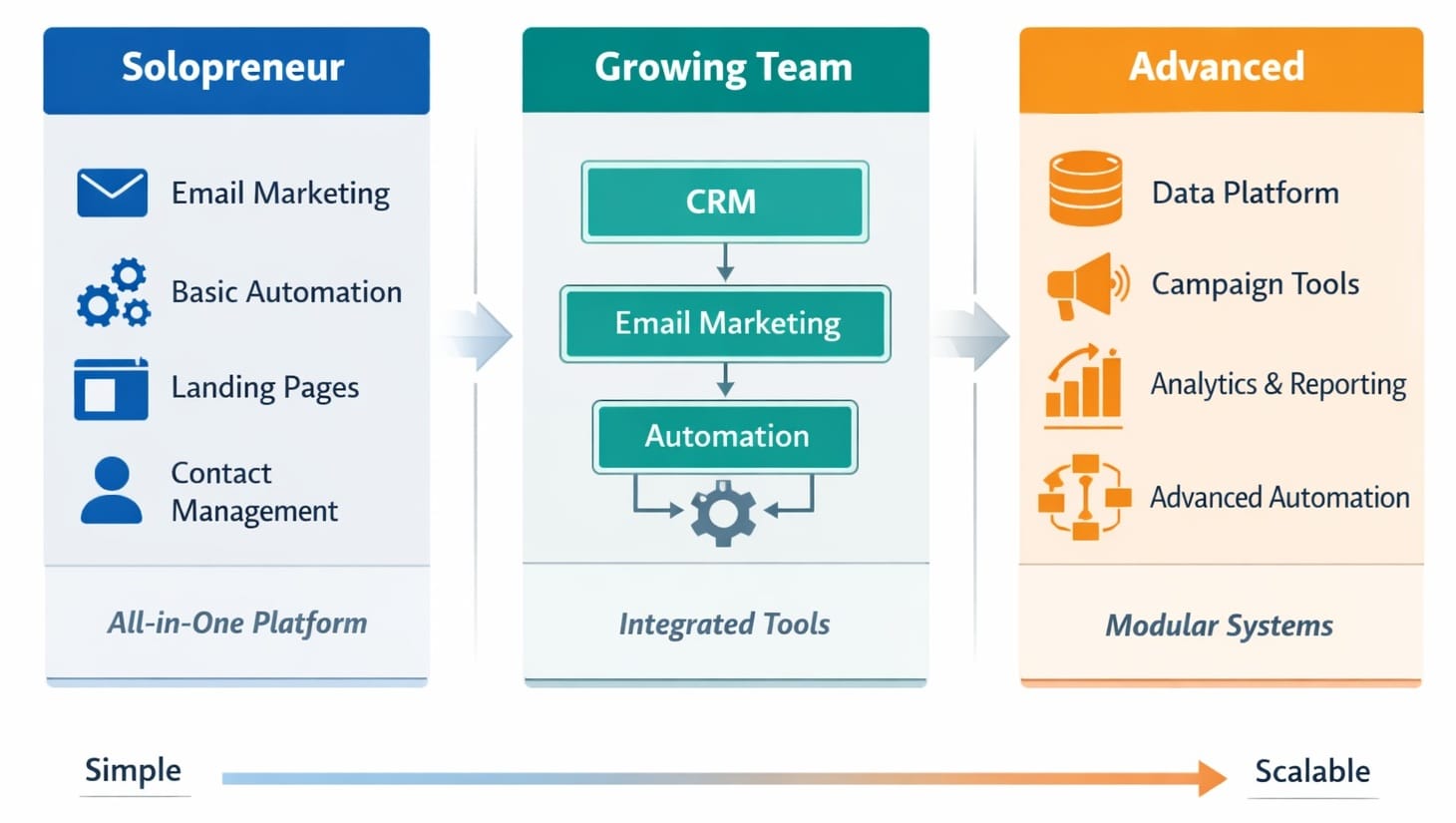
Here is how that translates into real-world marketing systems:
For solopreneurs or small businesses:
A single platform often handles email marketing, basic automation, landing pages, and contact management. The goal is to reduce tool switching and keep everything in one place.
For growing teams:
A slightly more structured stack may include a dedicated CRM, an email marketing platform, and an automation layer. Each tool has a clear role, and integrations ensure data flows between systems.
For more advanced organizations:
The stack becomes more modular, but still intentional. Each system supports a defined function such as data management, campaign execution, or reporting. The key difference is not more tools, but better coordination between them.
The goal at every stage is the same: fewer tools, clearer roles, and systems that support how your team actually works.
Common Mistakes When Building a MarTech Stack
Most marketing tech stacks become inefficient over time not because of bad tools, but because of how they are implemented.
Common issues include:
- Multiple tools performing the same function
- Buying tools before defining a system
- Systems that do not connect properly
- Over-automation too early
These issues create what many teams experience as tool fatigue, where the stack becomes harder to manage than the marketing itself.
How to Evaluate Your Current MarTech Stack
Before adding anything new, it is important to understand what you already have.
Ask yourself:
- Are multiple tools doing the same job?
- Is your data centralized or spread across platforms?
- Can you clearly explain your workflow from start to finish?
- Are you paying for tools you do not use?
If the answer is unclear, the issue is not a lack of tools. It is a lack of structure.
The Problem With “Franken-Stacks”
Most stacks are built reactively.
A CRM is added to solve one problem. An email tool is layered in later. Analytics live somewhere else. Project management happens in a spreadsheet. AI tools are bolted on without governance.
Individually, each decision makes sense. Collectively, they create friction.
The result is what we call a Franken-stack. Tools function in isolation. Data becomes fragmented. Reporting loses credibility. Teams spend more time managing platforms than executing strategy.
A lean stack does not eliminate tools. It aligns them.
The Five Layers of a Lean 2026 MarTech Stack
1. The Intelligence Layer: CRM and Customer Data
Your CRM is the brain of your marketing operation.
At a Director level, it must serve as the source of truth for customer and lead data. That does not mean it needs to be complex. It means it needs to be structured, accessible, and well-integrated. It also needs to be somewhat intuitive so everyone using it understands it.
Many organizations use HubSpot as a reference point because it demonstrates what a mature CRM architecture looks like: unified data, strong APIs, and clear ownership across teams.
That does not mean it is right for everyone.
Lighter platforms like Pipedrive can work well for sales-led or service-based businesses. The key is evaluating whether your CRM supports clean data flow, not just contact storage.
If your data cannot move cleanly, everything downstream suffers.
2. The Engine Layer: Automation and Messaging
Automation is how you scale expertise without scaling hours.
This layer handles email, follow-ups, lead nurturing, and lifecycle messaging. It is also where most marketing teams begin to feel overwhelmed.
The goal is not to add more tools, but to choose platforms that reduce complexity and bring multiple functions into one system.
For many businesses, an all-in-one platform is the most effective starting point. Instead of stitching together multiple tools, you can centralize email marketing, automation, landing pages, and basic CRM functionality in one place.
One example of this approach is Systeme.io, which combines email marketing, automation, funnels, and basic CRM functionality into a single platform. It works particularly well for solopreneurs and lean teams who want to reduce tool sprawl without sacrificing capability.
If you want a deeper breakdown of how this type of platform compares to other email and marketing tools, see our full comparison here.
The specific tool matters less than the structure behind it. Your automation system should reduce manual work, not create more of it.
If your workflows require constant troubleshooting or feel difficult to maintain, the issue is not your strategy. It is your system.
3. The Platform Layer: Website and CMS
Your website is not just a digital brochure. It is infrastructure.
For organizations focused on blogs, SEO, and authority-building, Ghost provides a clean, content-first environment with minimal overhead.
For teams that require broader flexibility, WordPress can work well when governed intentionally. The mistake is allowing plugins and themes to accumulate without oversight.
CMS decisions should be driven by content strategy, not aesthetics.
4. The Visibility Layer: Analytics and Reporting
If you cannot see what is happening across your stack, you cannot manage it.
Google Analytics remains a baseline tool and is free. However, raw analytics are rarely enough for decision-making.
Teams benefit from a single source of truth dashboard, often built in Looker Studio, that pulls data from multiple platforms into one view.
This reduces reporting friction and restores confidence in metrics.
5. The Strategy and Operations Layer: AI and Project Management
AI tools and project management platforms support execution when used intentionally.
Jasper fits well as an assisted thinking and drafting tool, especially when brand voice and strategy are clearly defined.
For operational clarity, platforms like monday.com help teams manage campaigns, audits, and cross-functional work without relying on informal systems.
These tools should support strategy, not replace it.
How This Stack Supports Scale
A lean stack scales because it is built around centralized strategy with flexible execution.
When data, automation logic, and reporting live at the core, organizations can expand without rebuilding infrastructure for every new initiative or market.
This is how systems remain stable as complexity increases.
Simplifying Your Stack Starts with Structure
The most effective marketing tech stacks are not built by adding more tools. They are built by aligning systems to how your marketing actually works.
Before introducing anything new, focus on:
- Clarifying your workflows
- Removing unnecessary tools
- Defining clear roles for each system
If your current stack feels harder to manage than it should be, the first step is not expansion. It is simplification.
Start with what you already have. Evaluate it clearly. Then build with intention.
If you have not yet audited your stack, download the free SaaS Audit Checklist to identify gaps, eliminate redundancy, and make better decisions about your marketing tools.
If you prefer a more structured approach, you can also apply for a Strategic Marketing and Communications Audit with us to get a clear, expert-led view of your current systems and where to simplify.
Frequently Asked Questions
Is this the best MarTech stack for everyone?
No. This post does not prescribe a single stack for every business.
It outlines a lean framework for structuring marketing technology in 2026. The right tools depend on your audience, operating model, scale, and internal capabilities. The purpose of this guide is to help you evaluate tools intentionally, not follow a fixed list.
Why are only a few tools mentioned in each category?
Because clarity matters more than choice.
This post focuses on how each layer of the stack should function rather than presenting exhaustive lists. Many organizations already own capable tools but struggle with alignment, integration, or governance. Direction comes before depth.
Can solopreneurs use a Director-level MarTech framework?
Yes, selectively.
Solopreneurs benefit from understanding how systems should be structured, even if they use lighter or lower-cost tools. The framework helps avoid overbuilding early and underbuilding later, which is a common source of tool fatigue.
In many cases, this means starting with a simplified, all-in-one platform that combines core functions like email, automation, and landing pages before expanding into a more modular stack.
Do I need all five layers to get started?
No.
Most organizations build their stack in phases. The important part is understanding the role of each layer so tools are added intentionally rather than reactively. A lean stack evolves with the business rather than being built all at once.
Are the tools mentioned required to follow this framework?
No.
The tools referenced are examples, not requirements. They are included because they illustrate how certain layers function well at scale.
For many businesses, especially early-stage or lean teams, an all-in-one platform such as systeme.io can support multiple layers within a single system. As complexity grows, additional tools can be introduced where needed.
How does this stack help reduce tool fatigue?
Tool fatigue happens when platforms overlap, data fragments, and ownership is unclear.
This framework reduces fatigue by clearly defining what each layer is responsible for and ensuring tools support one another rather than compete. Subtraction is often as important as addition.
How often should a MarTech stack be reviewed?
At least once per year.
Stacks change quietly. New tools are added. Old ones remain unused. Regular reviews help prevent fragmentation and ensure your infrastructure still supports how the business operates today.
How does this framework support growth or scaling?
By prioritizing interoperability and centralized logic.
When data, automation, and reporting are structured intentionally, organizations can grow without rebuilding infrastructure for every new initiative or market. This is especially important for multi-market or international operations.
What should I do if my current stack already feels messy?
Before adding new tools, start by evaluating what you already own.
A structured infrastructure audit often provides clarity on redundancy, misalignment, and data gaps. From there, decisions become easier and far less reactive.
If you want a clearer, step-by-step approach, start with a simplified system and rebuild around defined workflows rather than adding more tools on top of an already complex stack.
When in doubt, feel free to reach out to us for an audit.
About MarTech Authority
MarTech Authority provides practical, system-focused insights on marketing tools, automation, and infrastructure. Our goal is to help you simplify your stack and build systems that actually drive results, not just activity.
Please note that we only recommend tools and platforms that we believe provide real value. Your results will depend on how you use these tools and your overall strategy.


Comments ()