
MarTech Tool Fatigue: Why Too Many Marketing Tools Hurt Growth
Too many marketing tools can create complexity, duplicate work, and slow your growth. Learn how to fix MarTech tool fatigue and simplify your stack.

When More Tools Create Less Progress
In today’s marketing landscape, more tools rarely lead to better results.
Most marketing and communications leaders, entrepreneurs, and solopreneurs are not struggling because they lack technology. They are struggling because they have too much of it, and no clear strategy holding it all together.
The problem is not just inefficiency. It is that your marketing becomes harder to manage, harder to trust, and harder to scale.
Every week brings a new AI plugin, SaaS platform, or productivity app promising to unlock growth. Each one claims to be the missing piece. But without director-level infrastructure thinking, these tools quickly turn into digital clutter. Dashboards multiply. Logins pile up. Subscriptions quietly renew. Instead of feeling supported, teams feel overwhelmed by too many marketing tools.
This is the reality of MarTech tool fatigue. It is one of the most expensive and least visible problems in modern marketing operations.
Tool fatigue does not just slow teams down. It fractures data. It erodes confidence. Over time, it undermines performance in ways that are hard to measure but easy to feel.
What Is Tool Fatigue
Tool fatigue happens when technology outpaces strategy.
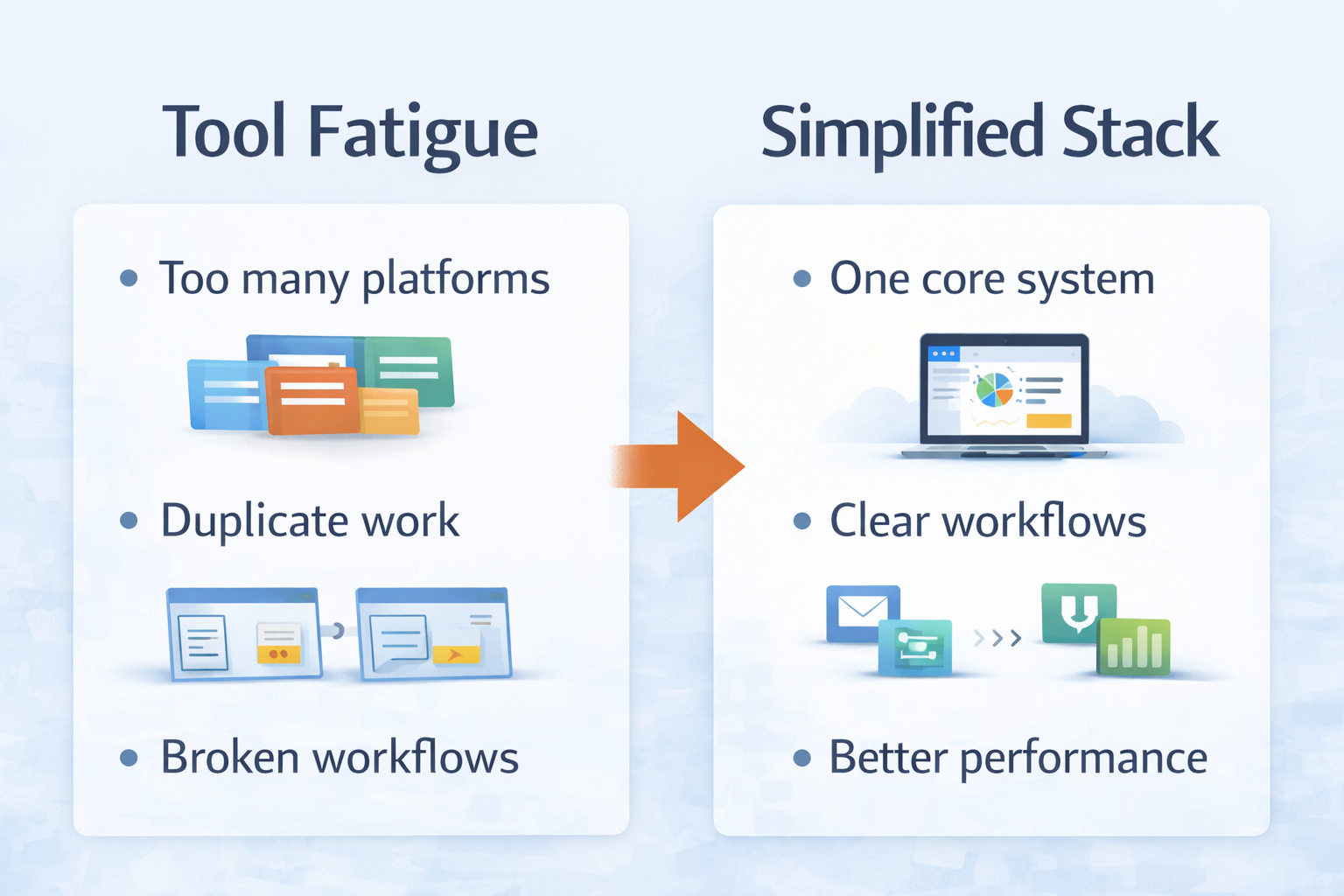
It shows up when teams are juggling too many platforms, each solving a narrow problem but never working together as a system. The stack grows reactively. One tool is added for email. Another for automation. Another for analytics. Another for AI. Very few are removed. And at the end of the day, you have too many marketing tools.
On paper, this looks like innovation. In practice, it creates friction.
Common signs of tool fatigue include duplicated data, inconsistent reporting, manual workarounds, and tools that only one person knows how to use. Over time, teams stop trusting dashboards and start relying on gut instinct again.
When that happens, the stack has stopped serving the business.
Why Most Businesses Stay Stuck in Tool Fatigue
Even when businesses recognize the problem, they continue adding tools instead of simplifying and end up with too many marketing tools.
This happens because new tools feel like progress. They promise better automation, better insights, or faster results.
But without a clear system, each new tool adds another layer of complexity.
The result is not better performance. It is a system that becomes harder to manage over time.
Why Tool Fatigue Keeps Getting Worse
Most businesses don’t realize that tool fatigue is not caused by having too many tools alone. It is caused by having too many tools without a clear system.
New platforms are often added to solve immediate problems. But without structure, each new tool introduces more complexity, more manual work, and more points of failure.
Over time, this creates a system that is harder to manage, harder to scale, and harder to trust.
The Real Cost of a Fragmented Marketing Stack
At first glance, tool fatigue looks like clutter. Too many tabs. Too many platforms. Too many passwords. But the real cost runs much deeper.
When your lead capture tool does not properly sync with your CRM, attribution breaks. When email marketing lives in a different system than your booking or event platform, engagement data becomes unreliable. When analytics, automation, and reporting are scattered across tools, decision making slows down.
This is not just inefficient. It is risky.
Disconnected stacks create data loss, duplicated records, and reporting gaps that compound over time. Teams spend hours reconciling numbers instead of acting on them. Leaders lose confidence in performance metrics. Strategy becomes reactive instead of intentional.
The most dangerous part is that these costs are rarely obvious. They hide in manual processes, missed opportunities, and decisions made on incomplete information. This is why we focus on the Three Pillars of Infrastructure to ensure growth is intentional
Why Buying More Tools Rarely Fixes the Problem
When performance stalls, the default response is often to add another tool.
A new platform promises better automation. A new dashboard promises better visibility. A new AI feature promises to save time. Each purchase feels reasonable in isolation.
The problem is that most stacks grow without governance.
Tools are added to solve immediate needs, not long-term workflows. Vendors market directly to practitioners, not system owners. Without someone accountable for the full infrastructure, complexity compounds and many find themselves with too many marketing tools.
This is how teams end up paying for tools they barely use, maintaining systems they no longer trust, and feeling stuck inside stacks that feel too big to untangle.
The issue is not the tools themselves. The issue is the absence of infrastructure thinking.
If you’re looking for a simpler way to manage your tools, our breakdown of the best all-in-one marketing platforms can help you reduce complexity and streamline your stack.
Why Most Businesses Stay Stuck in Tool Fatigue
Even when businesses recognize the problem, they continue adding tools instead of simplifying.
This happens because new tools feel like progress. They promise better automation, better insights, or faster results.
But without a clear system, each new tool adds another layer of complexity.
At some point, more tools stop helping and start getting in the way.
The result is not better performance. It is a system that becomes harder to manage over time.
The Infrastructure Audit: A Director-Level Reset
MarTech Authority exists to address this exact challenge. Whether you are a solopreneur or leading a lean team, the solution is not another platform. It is a reset.
That reset starts with an infrastructure audit.
A proper audit reframes your marketing technology as a single system, not a collection of products. It focuses on clarity, connection, and return on investment.
An effective infrastructure audit follows three core principles.
1. Inventory Everything Without Exceptions
You cannot improve what you have not fully mapped.
The first step is a complete inventory of every marketing and operational tool in use. This includes paid subscriptions, free tiers, trials, and tools that were meant to be temporary but never removed.
A simple rule applies here. If you have not logged into a tool in the last 30 days, it is likely a liability, not an asset.
Unused tools still create noise. They complicate onboarding. They inflate budgets. They add cognitive load. Most audits reveal significant wasted spend once everything is visible in one place.
2. Confirm How Data Moves Between Tools
A marketing stack is only as strong as its connections.
Every tool should have a clear role and a clear relationship to the others. That may be a native integration, an automation workflow, or a documented manual process. What matters is that it exists and is intentional.
Key questions to ask include where data originates, where it is enriched, and where it ultimately lives as the source of truth.
If customer or lead data exists in multiple places without consistency, your stack is leaking value. Clean handoffs matter more than advanced features.
3. Choose Adoption Over Feature Depth
Many teams select tools based on what they could do, not what they actually use.
A simpler platform that is used consistently will outperform a complex system that intimidates users. Features do not create ROI. Adoption does.
Every tool in your stack should earn its place by supporting a measurable outcome. If the value is unclear or hypothetical, it is a sign the tool may not belong.
Strong stacks are often boring by design. They favor clarity, usability, and alignment over novelty.
Shifting From Tool Chasing to Infrastructure Building
When teams stop chasing tools and start building infrastructure, everything changes.
Marketing becomes calmer. Data becomes more trustworthy. Reporting becomes easier. Teams spend less time managing software and more time doing meaningful work.
For solopreneurs, this often means reclaiming hours each week. For organizations, it means fewer fire drills and more strategic momentum. In both cases, the result is focus.
Infrastructure building creates stability. It allows teams to scale without constantly reworking systems. It turns technology into a quiet support system instead of a daily source of friction.
What a Clean Marketing Stack Actually Enables
A clean stack does more than reduce stress.
It enables clearer forecasting, stronger attribution, and better decision making. It supports sustainable growth instead of constant reinvention. It creates space for creativity because the foundation is solid.
Most importantly, it restores trust. Trust in data. Trust in processes. Trust that the systems in place are actually helping, not holding the team back.
If you’re ready to simplify your stack, explore our breakdown of the best all-in-one marketing platforms.
What Comes Next
Tool fatigue is not a sign that you need more tools. It is a sign that your system needs to change.
Before adding anything new, take a step back and simplify what you already have.
In many cases, clarity, not complexity, is what drives better results.
Frequently Asked Questions
What is MarTech tool fatigue?
MarTech tool fatigue happens when businesses use too many disconnected marketing tools, creating complexity, inefficiency, and fragmented data instead of improving performance.
How do I know if I have too many marketing tools?
If your team is spending more time managing tools than executing campaigns, duplicating work across platforms, or struggling to trust your data, your stack is likely too complex.
Should I reduce the number of tools in my marketing stack?
In many cases, yes. Simplifying your stack can reduce manual work, improve data accuracy, and make your marketing systems easier to manage and scale.
What is the best way to simplify a MarTech stack?
Start by identifying overlapping tools, removing unused platforms, and consolidating functions into fewer systems. In some cases, an all-in-one platform can replace multiple tools.
Are all-in-one marketing platforms better?
All-in-one platforms can simplify your stack by reducing the number of tools you need. However, the best approach depends on your business size, complexity, and goals.
About MarTech Authority
MarTech Authority provides practical, system-focused insights on marketing tools, automation, and infrastructure. Our goal is to help you simplify your stack and build systems that actually drive results, not just activity.
Please note that we only recommend tools and platforms that we believe provide real value. Your results will depend on how you use these tools and your overall strategy.



Comments ()